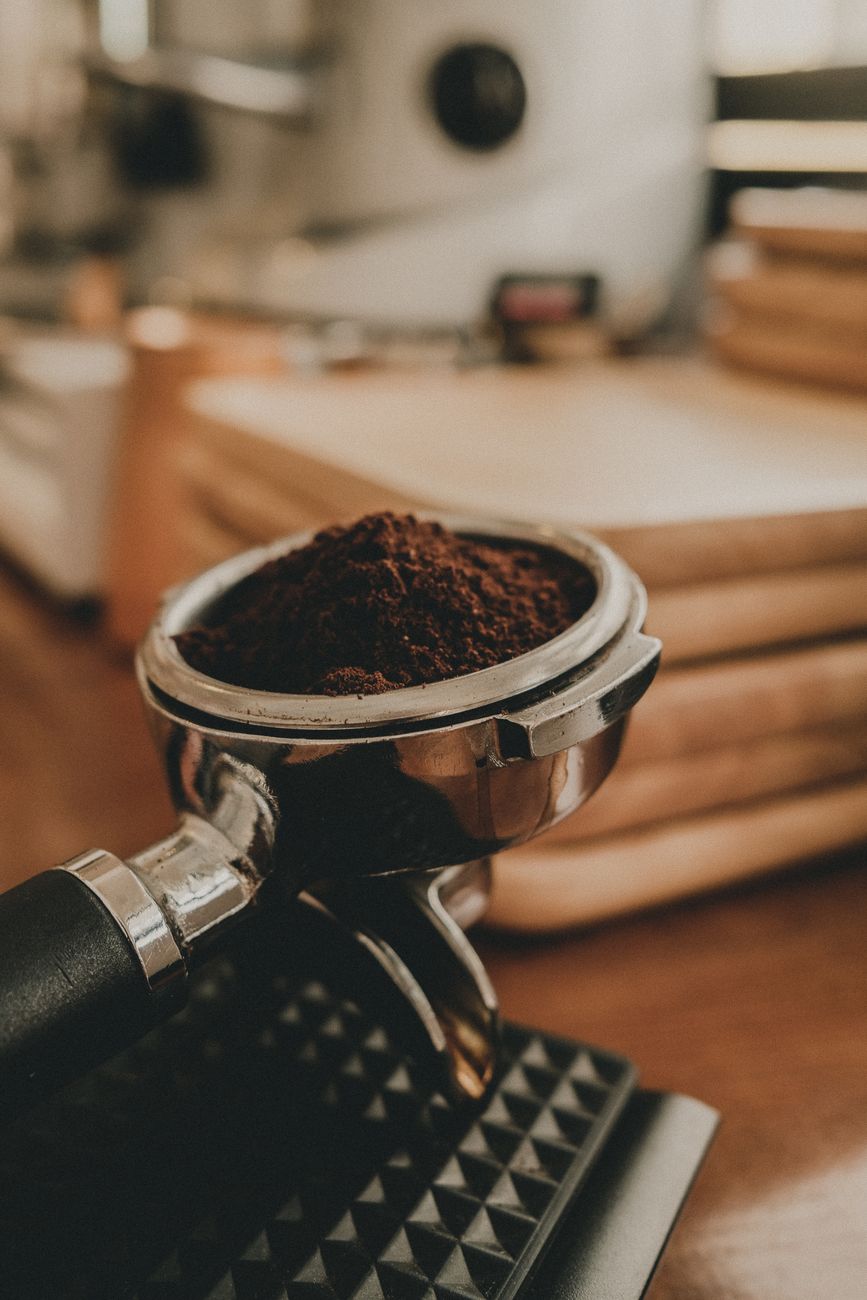
Judah thinks my espresso machine is his, and I can’t blame him. It has a portafilter and a tamper, a little distributor for spreading the grounds, a scale with a glowing display, and a steam wand. To a two-and-a-half-year-old, it’s a Fisher Price workshop.
He knows the sound of the machine turning on. The second I fire up the grinder and start dosing beans, he comes running. Eeeerrrk! He drags a chair across the kitchen, climbs up, and gets to work “helping.”
One night my wife and I decided to go out for ice cream, but Judah had other plans. He was already up on his chair, fiddling with the portafilter, fully committed to his shift as barista. I walked over to tell him we were all going.
“Judah, let’s go get some ice cream.”
I reached for his hand to help him down.
“No!”
He grabbed the portafilter and held on tight.
“Judah. Come on, buddy. We’re going to get ice cream.”
“No!”
He doesn’t say much yet, but he understands most of what we tell him, and he understood me. He heard every word. He just had no room for it because his hands were full. He was happy and busy, and he couldn’t see that I was offering him something so much better than what he was holding on to.
I could have won that argument in two seconds. I’m bigger and stronger. I could have peeled his fingers off the handle and carried him to the car. Plenty of nights, that’s probably the right call. This time, though, I stayed. I pulled up next to him and let him play.
We weighed out 18 grams and ground them fine. Judah dumped the grounds into the portafilter and ran the distributor through them—his favorite part. Then he took hold of the tamper, I put my hand over his, and we pushed down together. He loaded it into the grouphead himself. We brewed a double shot at 7:30 at night, a questionable decision that I’d definitely make again.
He handed the shot to me. I handed him his own little cup (full of water). We made a clink, said “Cheers!” then he took a sip and said, “Ah!”
I looked at him and said, “Okay. Can we get some ice cream now?”
“Cream!” he shouted and was off the chair before I’d finished asking. He ran to the door, put on his shoes, then his coat, and rushed outside.
I keep thinking back to that kitchen. C.S. Lewis has a passage in The Weight of Glory about a child who would rather keep making mud pies in a slum, because he can’t imagine what anyone means by a holiday at the sea. Lewis says the Lord finds our desires too weak, and he sums us up simply: “We are far too easily pleased.”
I always read that passage as a verdict on other people’s mud pies, the obviously cheap stuff. That night I looked down and saw my own hands holding fast to the portafilter.
My hands aren’t gripping anything cheap and disposable, and that’s the trouble. It’s the work I care about, the plans I’ve made, the things I’m trying to get right for people I love. Most of it is good. But I hold it the way Judah held that handle, and when my Father says “Come on, I’ve got something better for you!” I say no! Not out loud. Instead, I say it by staying busy.
With my son, I didn’t pry it away from him. I sat down in the middle of his small, happy mess and made the coffee with him, because I knew where we were headed and he didn’t. I wonder how many times God has done the same with me–sat down beside me in the thing I was clutching, patient, while I told him no, until I was finally ready to hear what he’d been trying to tell me the whole time.
Jesus says that if we–flawed as we are–know how to give our children good gifts, how much more will our Father in heaven give good things to those who ask him (Matthew 7:11). That’s a truth I find easy to believe when I’m sitting in a pew at church. It’s harder to believe when I’m working at the counter, with both hands full.
Judah is just a boy dragging a chair across the floor to stand next to me. I had the opportunity to slow down, meet him where he was, and wait for him to realize where we both needed to be. He got there eventually, and beat me to the car. I’m glad I didn’t waste my time rushing him toward the door.
This is a lesson I’m still learning. Most days I’m still up on the chair, hands wrapped around something I can’t set down. But I think about Judah running for the door, shoes on, coat on, not giving the portafilter another thought, and I think that’s what’s waiting when I finally let go. A Father already at the door, keys in his hand, in no hurry at all.
Too Easily Pleased
in


Leave a Reply