He built the fire slowly but carefully—just as his older brother taught him. You put some small kindling in the middle, then build outward with small sticks. Stack the sticks in a square pattern. Using the lighter, he ignited the kindling in several spots, then began feeding it with air from his lungs. A thin orange line crawled up the kindling and licked the wood that lay on top of it. The young boy sat back on his heels with a wide, satisfied grin streaking across his face.
We stood there, still shivering despite the small flame that now danced before us. But the look of reverent accomplishment glinting in his eyes was warming in its own way. He had worked hard for this fire, and the result was all the more rewarding because he had toiled for it.
Creating something is sacred but endangered. Type a few words into a text box, punch the return key, and nine seconds later there’s a painting, or a poem, or a ten-page paper. No work, no strain, and no toiling. Often, it’s surprisingly good, and that’s what makes it dangerous.
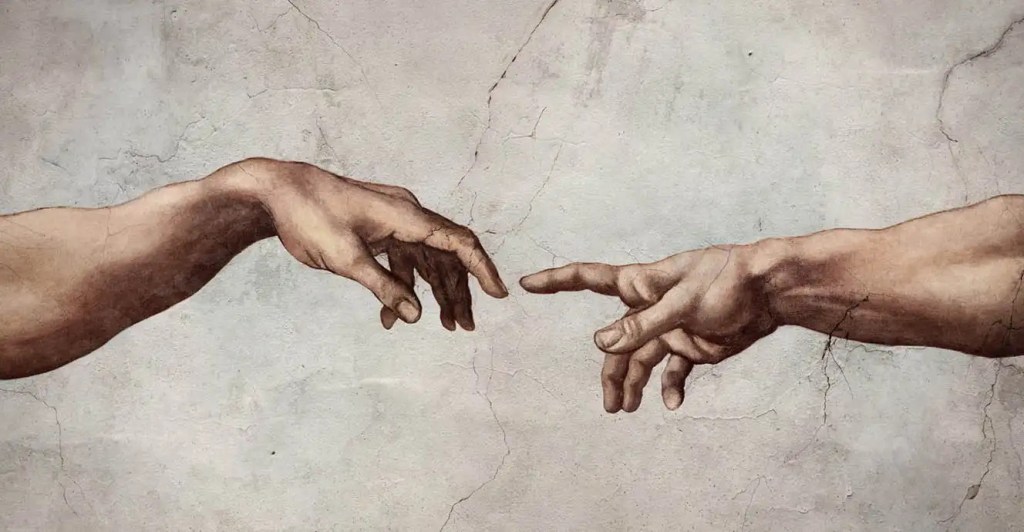
Creatio ex nihilo is an old phrase for what God did in the beginning. He made something out of nothing, and he did it by speaking. Paul calls Him the God who “calls into existence the things that do not exist” (Romans 4:17). Hebrews 11:3 says we see what was not made from visible things. In the beginning there were no raw materials, no first draft leading into a second attempt, and no mistakes. At one time there was no light. Then God spoke, and light was there.
That power—to create something out of nothing—is reserved by Him alone. Whenever we make something, we make it out of something that was already made. “Matter cannot be created or destroyed [unless you’re God].”
Generative AI looks like a knockoff of the first thing. You put in a sentence, and something “new” comes out. It’s not really new, but merely created from a world of existing materials. It simply but powerfully gives the appearance of something from nothing. The AI model starts with nothing of its own and delivers something assembled from what millions of people already composed. These systems can produce things that appear new and surprising, but they can’t create ex nihilo, and more importantly, they don’t bear God’s image.
Satan has been working this angle longer than anyone. Scripture tells that he is a creature. Ezekiel 28 describes him as “created” (v. 15), and Isaiah 14 reveals that he desires to “make [him]self like the Most High” (v. 14). A creature can’t speak things into being, so he does what creatures do, which is work with what has been created.
Watch what Satan does in Genesis 3. God created the garden and everything in it, and it belonged to Him. Satan’s opening act—his famous line, “Did God actually say…?” borrows God’s own words, twists and turns them into something different. He invents nothing, but rearranges what’s there and leaves a gap of doubt where truth once was. That’s the closest thing he can do to making something out of nothing—a distortion.
He sold Eve a chance to be like God. She was already made in the image of God. She was already like him in every way a creature could be. He offered her a chance to go from receiving to reaching to be like God. The irony is that, in their hubris, humanity ends up less like God than it was meant to be.
In Matthew 4, he tries the same tactic on Jesus: “Command these stones to become loaves of bread.” Speak it and make it so. When that fails, he quotes Psalm 91, “He will command his angels concerning you…” His final attempt is an offer of worldly kingdoms—that which has no claim—under the condition that Jesus worship him.
Jump to Exodus 7 and 8 to the battle between Moses and Pharaoh’s magicians. They match Moses on the snakes, then the blood, then the frogs, until Aaron strikes the dust and gnats swarm out of it. The magicians try, but can’t. “This is the finger of God,” they tell Pharaoh (Exodus 8:19). Whatever power stood behind them, it hit its limit.
Augustine argued that evil has no substance of its own, only a twisting of the good God made. Tolkien told his own version out of the mouth of Frodo, “The Shadow that bred them can only mock, it cannot make: not real things of its own. I don’t think it gave life to the orcs, it only ruined them and twisted them.”
Every version of that temptation takes the same shape of a shortcut to something that should have cost you. Generative AI is the most alluring shortcut. Someone with no training and no hours can produce something impressive and, for a moment, feel like they spoke it into existence. It’s a good feeling, and that’s the trouble. That blank box with the blink line is hungry and asks for a second helping. The next prompt comes easier than the first, and the thing you used to do with your own hands starts to feel like wasted effort. Creative skills wither when we hand them off like a deteriorating muscle.
Making things is one way we worship. Paul tells the Colossians to work heartily at whatever they do, as for the Lord (Colossians 3:23). The effort becomes the offering. Listening to a recording of a congregation singing doesn’t count toward my credit. I still have to open my mouth. It’s not enough to allow the machine to do the making.
That’s not to say that AI can’t be a useful tool. A lot of work is only work: reformatting a schedule, cleaning up a spreadsheet, finding the typo on the twentieth page. I don’t think God is waiting for me at the end of a long formatting session. The question I ask is: “What is the tool taking off my plate?” If it’s a simple task, that’s fine. But if it requires creative effort, then it’s taking something that was supposed to cost me.
That boy will light his fire again tomorrow. It will be a small one that will smoke, and he’ll cough, and onlookers may think they could’ve done it faster. God made the first light simply by speaking, and nothing we build will ever match that. He could have created the whole world to completion and left nothing for us to do. Instead, he put us in a garden with work to do—and it’s our work to do.


Leave a Reply